


The Technical Roadmap to Becoming an AI Engineer (Skills, Projects, Internships, Hackathons)
A technical, step-by-step roadmap to become an AI Engineer: skills to learn, projects to build, internships and hackathons to target.
Download the PDF at the bottom
So you want to become an AI Engineer — the kind of engineer who could work at a company building products like Claude or ChatGPT. That's a great goal, but "learn AI" is too vague to act on. What you actually need is a sequence: specific skills, in a specific order, proven through specific projects.
This roadmap breaks it into 6 phases. Each one builds on the last — skipping ahead usually shows up as a gap in your first technical interview.
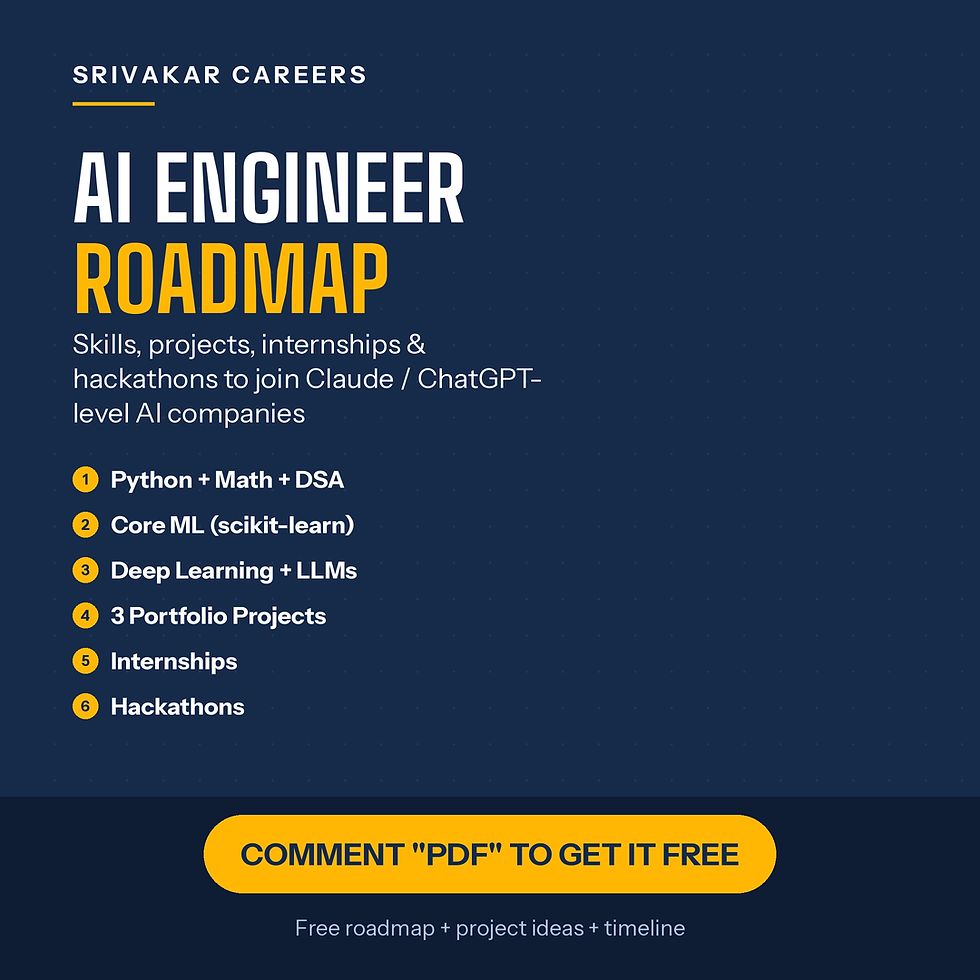
The 6-Phase Flow
Foundations — Python, Math, DSA
Core ML — scikit-learn, classical models
Deep Learning & LLMs — PyTorch, transformers, RAG
Portfolio Projects — 3 projects, increasing difficulty
Internships — apply early, get noticed
Hackathons — ship fast, build proof
Let's go through each one.
Phase 1: Foundations (Month 1 to 2)
Before any machine learning, you need the basics that every later phase depends on.
Python — functions, OOP basics, file handling, virtual environments. Every ML library you'll touch (PyTorch, scikit-learn, Hugging Face) is Python-first. Weak Python slows down everything after this.
Data Structures & Algorithms — arrays, hashmaps, trees, graphs, recursion, time/space complexity. Most AI engineering interviews, even at AI-focused companies, still open with a DSA round before any ML discussion.
Math for ML — linear algebra, probability and statistics, basic calculus. Neural networks are matrix operations trained by gradients. Without this, deep learning stays a black box you can't debug or improve.
Git — branches, pull requests, commit hygiene. Assumed knowledge from day one of any internship.
Phase 2: Core Machine Learning (Month 2 to 4)
Learn classical ML before deep learning, so you understand what deep learning is actually improving on.
Libraries — NumPy, pandas, scikit-learn, matplotlib/seaborn. These are the exact tools used to clean data and try models fast; recruiters expect fluency here.
Concepts — train/test/validation splits, overfitting, cross-validation, evaluation metrics (accuracy, precision, recall, F1, AUC). This is how every model — classical or deep learning — gets judged as actually working.
Algorithms — linear/logistic regression, decision trees, random forests, k-means, gradient boosting. Still the default choice for many real production problems because they're fast and explainable.
Phase 3: Deep Learning & LLM Foundations (Month 4 to 7)
This is the core of what AI companies actually build products with.
PyTorch — preferred by nearly every research-driven AI company over TensorFlow, for its flexibility in experimentation.
Neural network basics — backpropagation, activation functions, CNNs, RNNs. Transformers are built from these same ideas.
Transformers & LLMs — attention mechanism, tokenization, how models like Claude and ChatGPT are trained and fine-tuned. This is the literal architecture behind every modern LLM.
Practical LLM skills — prompt engineering, fine-tuning open models, embeddings, Retrieval-Augmented Generation (RAG). This is the actual day-to-day work of an applied AI engineer right now — most real product work is RAG and fine-tuning, not training models from scratch.
Tools — Hugging Face Transformers, LangChain or LlamaIndex, a vector database (FAISS, Pinecone, Chroma).
Phase 4: Build a Portfolio That Proves You Are an AI Engineer
Recruiters look for projects that solve a real problem, not copied tutorials. Aim for 3, in increasing difficulty:
Level | Project idea | What it proves |
Starter | A RAG chatbot over your own documents | You can connect an LLM to real, custom data |
Intermediate | Fine-tune a small open-source model for a specific task | You understand fine-tuning, not just prompting |
Advanced | Reproduce a paper's core result, or build an evaluation benchmark | You can read research and implement it correctly |
Push every project to GitHub with a clear README. Treat your GitHub as a second resume — many AI companies look at it before or instead of a cover letter.
Phase 5: Internships
Target three tiers: AI companies directly, AI-focused teams at larger tech companies, and startups building on LLM APIs (easier entry, fast hands-on learning).
Apply early — most structured programs open applications 4 to 6 months ahead.
Keep a public GitHub and a "Featured" section on LinkedIn with your top 2-3 projects — many teams source candidates this way.
Expect interviews to mix DSA, ML fundamentals, and a deep dive into your own projects. Be ready to explain every design choice.
Phase 6: Hackathons
Compress the "build something real" experience into 24-48 hours — exactly the signal AI companies look for.
Find them on Devpost, MLH, university hackathons, and AI-company-sponsored events (often with direct recruiter access).
Pick an AI/LLM track, build something that works end to end, and record a short demo.
Afterward, publish it on GitHub and write about what you learned — this turns a weekend into permanent proof.
A Sample 6 to 9 Month Timeline
Month | Focus |
1–2 | Python, DSA, math for ML |
2–4 | Core ML + first Kaggle-style project |
4–6 | Deep learning + LLM foundations |
5–6 | First RAG project; start applying to internships |
6–7 | Fine-tune a model; join 1-2 hackathons |
7–9 | Advanced project; polish resume; apply widely |

Comments